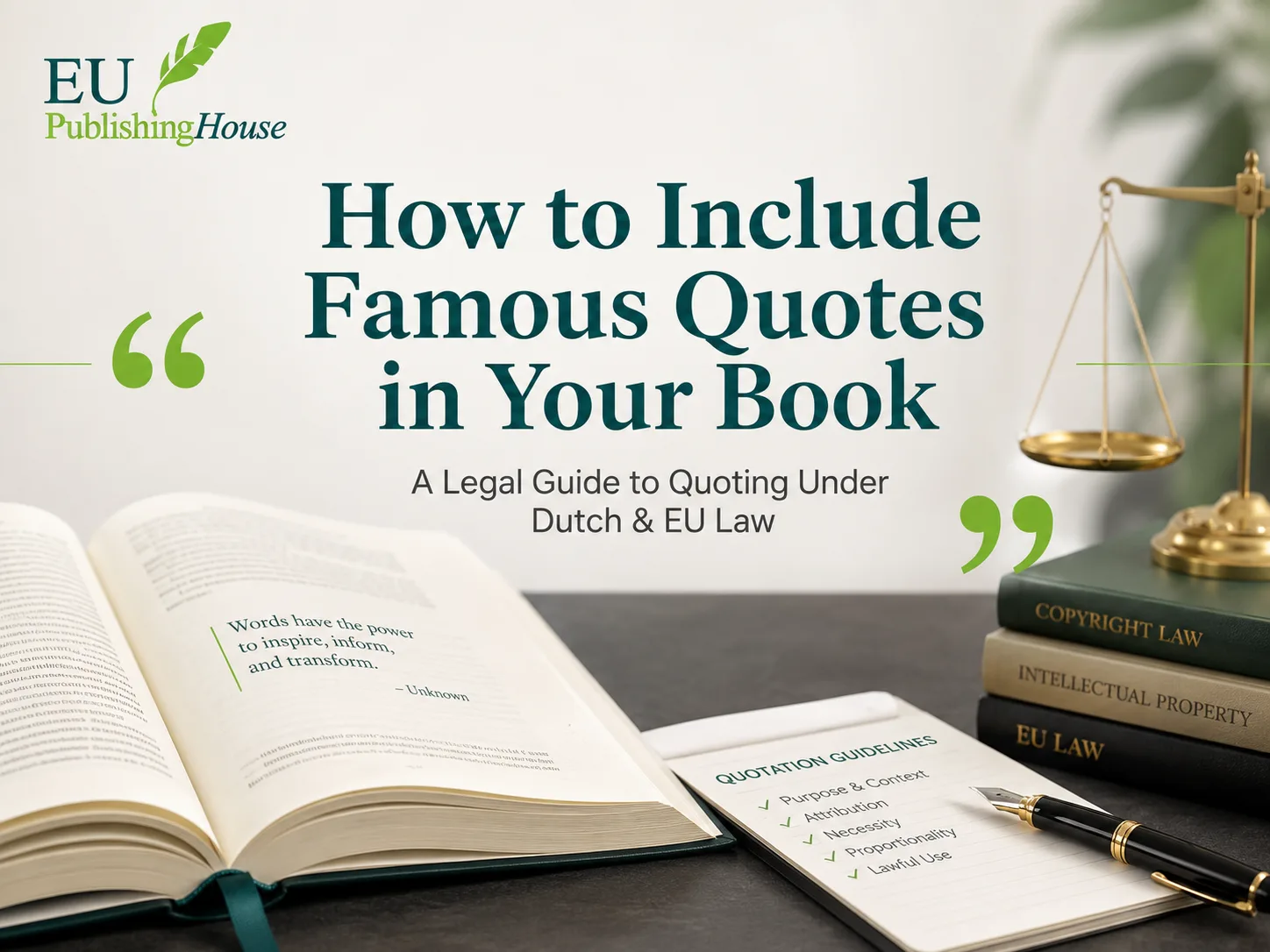
You've found the perfect quote. It captures the essence of your chapter, it adds a little authority to your argument, and it lands exactly the way you hoped it would with your reader. And then a single question stops you cold: can you actually use it?
That hesitation is healthy. It's also the reason most authors either avoid quotes altogether or, worse, paste them in and hope nobody notices. Both are mistakes. The fear of getting a copyright claim is real, and a single misstep can lead to a take-down request, a sternly worded letter, or a settlement you never budgeted for. Self-publishers feel this most sharply, because there's no publishing-house legal team standing between you and the rights holder. It's just you.
Here's the thing though. Knowing how to quote in a book properly isn't some dark art reserved for lawyers. It comes down to a handful of clear principles, most of which you can learn in an afternoon. Is this quote in the public domain? Does the quotation right cover me? And if neither applies, how do I actually ask for permission without it turning into a nightmare?
This guide walks you through all of it. We'll cover the basics of Dutch and EU copyright, the quotation right (citaatrecht), the public domain, the permissions process, and the trickier cases like song lyrics that catch even experienced writers out. At EU Publishing House, we've watched too many authors learn these lessons the hard way, after the book was already out. By the end of this, you won't be guessing. You'll have a clear, workable plan to include quotes confidently and legally. Let's get into it.
What Copyright Actually Protects (and What It Doesn't)
Before you can decide whether a quote is safe to use, you need to know what copyright actually covers. And it's narrower than most people assume.
Copyright, or auteursrecht in Dutch, protects original creative works fixed in some tangible form. Books, articles, song lyrics, poems, film scripts, speeches, all of it. The law hands the maker, that's the legal term for the creator, a set of exclusive rights: to reproduce the work, distribute it, and communicate it to the public. On top of that, makers have what are called moral rights (persoonlijkheidsrechten), which include the right to be named as the author and the right not to have their work distorted. For you, the person quoting someone else, this all adds up to one practical rule: you generally need permission to use another person's copyrighted expression, unless an exception like the quotation right applies.
But, and this is the part that gives you breathing room, copyright doesn't protect everything. It doesn't protect facts. It doesn't protect ideas. And it doesn't protect very short, ordinary phrases (although trademark law can sometimes step in there). So if you want to reference the idea behind someone's argument, or state a fact they happened to mention, you're free to do that in your own words without anyone's blessing. The protection attaches to the specific expression, the actual words in their actual order, not to the underlying thought.
Understanding where that boundary sits is genuinely your first step. A lot of anxiety about quotations in books melts away once you realise how much of what you want to do isn't restricted at all.
Expert Tip: Check the source date first. Under EU and Dutch law a work generally enters the public domain 70 years after the death of its maker, calculated from 1 January of the following year. But verify it through a reliable database rather than assuming.
How Long Copyright Lasts: The 2026 Thresholds
So how long does this protection actually last? In the Netherlands and right across the EU, copyright runs for the life of the maker plus 70 years, counted from 1 January of the year after they die. If a work has more than one author, the clock starts ticking from the death of the last surviving one. For anonymous or pseudonymous works, where there's no identifiable maker to measure against, the term is generally 70 years from the date the work was lawfully published.
Let's make that concrete. As of 2026, this means works by makers who died in 1955 or earlier are, as a general rule, in the public domain in the Netherlands. That's your rough dividing line. But, and I cannot stress this enough, always confirm the maker's actual date of death rather than leaning on the publication date. A book printed in 1940 can still be firmly in copyright today if its author lived a long life and died in, say, 1968.
The Public Domain vs. Copyrighted Works
A work in the public domain belongs to everyone. You can quote it, reprint it, adapt it, build on it, all without asking anyone. That's the prize, and it's why working out public domain status matters so much.
The catch is that it isn't always obvious. Different countries run different rules, and some works have had their terms restored or extended in ways that trip people up. We'll dig into the verification methods properly later on. For now, just hold onto one principle: "old" does not automatically mean "public domain." Plenty of authors have looked at a quote from the 1950s, assumed it was fair game because it felt old, and walked straight into a problem.
If you're at the stage of building any kind of book and want a clearer picture of how all this fits into the wider production process, the team at EU Publishing House's publishing services can help you think it through end to end.
International Copyright Considerations for Global Distribution
Here's where it gets a touch more complicated, and it's worth a moment of your attention because it affects nearly every self-publisher now.
When you distribute through Amazon KDP or IngramSpark, your book doesn't just stay in the Netherlands. It reaches a global audience the moment you hit publish. And copyright terms vary by country. The EU and the United Kingdom both use life plus 70 years. Canada has historically used life plus 50 (though that's been changing). The United States works completely differently, relying on a fixed cut-off date where, broadly, works published before 1929 are in the public domain there.
What this means in practice is uncomfortable but simple: a quote that's safely public domain in one country might still be protected in another. We'll come back to this in the self-publishing section, but for now, just file it away. International distribution adds a layer of complexity that domestic-only authors never have to think about.
The Quotation Right (Citaatrecht) Explained for Book Authors
Now we get to the heart of how to quote legally in the Netherlands, and it's where a lot of online advice goes badly wrong.
You may have read American articles about "fair use." Forget them. The Netherlands does not have the American fair use doctrine. What Dutch law gives you instead is a statutory quotation right under Article 15a of the Copyright Act (Auteurswet), which lines up with the EU Copyright Directive. This is the legal basis that lets you quote from a copyrighted work without first getting permission. But, and this is the critical bit, it only applies if you meet all of the following conditions. Not most of them. All of them. There's no à la carte version in which you pick the conditions you like.
Let's go through them one by one.
Condition 1: The Work Has Already Been Lawfully Published
You can only quote from a work that's already been lawfully made public, with the maker's consent. This rules out unpublished manuscripts, private letters, leaked documents, and anything that found its way into the open without the author's say-so. If it wasn't meant to be public yet, the quotation right won't shelter you.
Condition 2: The Quote Serves a Legitimate Purpose
The quote has to do a job. It needs to serve a genuine purpose, a review, a piece of criticism, scholarly discussion, news reporting, or something comparable. Using a quote to actually engage with it, to illustrate a point or support an argument in your non-fiction book, fits comfortably. Dropping a quote in purely as decoration, or to pad out a thin page, does not. The law wants the quote to be doing intellectual work, not just sitting there looking pretty.
Expert Tip: Make the function of every quote visible. A quote that's clearly discussed, analysed, or commented on sits comfortably within the quotation right. A quote dropped in as an epigraph with no surrounding discussion is far weaker.
Condition 3: The Quotation Is Proportionate
How much can you take? Only as much as the purpose genuinely requires. There's no magic word count, no safe number you can point to, and "proportionate" always depends on context. The guiding instinct should be: quote no more than you actually need to make your point. And watch out for the "heart" of a work, that one devastating line, the key stanza, the passage everyone remembers. Taking the heart of something, even if it's short, weighs against you. For prose, a tight excerpt that supports your discussion is far safer than reproducing whole paragraphs.
Expert Tip: Shorter is safer. While no word count guarantees you stay within the quotation right, a short, well-integrated excerpt is far lower risk than long passages reproduced for their own sake.
Condition 4: Source and Author Must Be Named
This one is non-negotiable and it's the condition authors forget most often. You must clearly name the source and the maker, wherever it's reasonably possible to do so. Under the quotation right, this isn't a courtesy or a nice-to-have. It's a legal requirement. Skip it and you've broken the conditions, even if everything else was perfect. You also have to respect the maker's moral rights, which means you can't distort the quote or twist it to mean something the author never intended.
Get all four of these right, together, and you can quote without asking. Miss one, and you're back to needing permission. It really is that binary.
Quotation-Right Decision Flowchart
Sometimes it helps to see the logic laid out as a series of decisions. Here's the thought process, step by step, that you can run any quote through:
-
Is the work still in copyright? → No → Use it freely, it's public domain.
-
Has the work been lawfully published? → No → You can't rely on the quotation right. Seek permission.
-
Does the quote serve a review, critical, or scholarly purpose? → No → You'll likely need permission.
-
Is the amount you're using proportionate — and not the 'heart' of the work? → No → Higher risk. Cut it down or seek permission.
-
Have you named the source and the author, and respected moral rights? → No → Fix this before you publish anything.
-
All conditions met? → The quotation right likely applies. But write down your reasoning anyway.
That last point matters more than it looks. Documenting why you believed a quote was covered is cheap insurance. If anyone ever questions it, you've got your reasoning ready instead of scrambling to reconstruct it.
Public Domain Quotes: How to Identify and Use Them Safely
If the quotation right feels like walking a tightrope, public domain quotes are the wide, flat path beside it. No permission, no conditions, no anxiety. The trick is being certain a work has genuinely entered the public domain before you treat it that way.
The Life-Plus-70 Rule and Beyond
We touched on this earlier, but let's nail it down. In the Netherlands and the EU, a work generally falls into the public domain 70 years after the maker's death, calculated from 1 January of the following year. As of 2026, that points to makers who died in 1955 or earlier. For anonymous or pseudonymous works, the 70 years usually runs from lawful publication instead. Whatever you do, verify the maker's death date through a reliable source. Don't take a random website's word that a quote is "public domain", because half of them are wrong and none of them will be there to defend you.
Verifying Public Domain Status: Reliable Databases and Tools
So where do you actually check? Library catalogues are a strong start. The DBNL (Digitale Bibliotheek voor de Nederlandse Letteren) is excellent for Dutch literary works, and the Koninklijke Bibliotheek (KB) is authoritative for confirming dates and details. Solid biographical references work too. For foreign works, you'll need to check the copyright rules in the country of origin, since the term might differ. And one more time, because it's the single most common error: never assume a quote you found on a quote-aggregation site is in the public domain. Those sites almost never verify, and they're not the ones who'll get the letter.
Expert Tip: Always confirm the date of death, not just the publication date. A book printed in 1940 can still be in copyright in 2026 if its author lived into the 1960s.
International Public Domain Differences
This is the part global authors genuinely must understand. A work can be public domain in one country and still protected in another, thanks to different term lengths or something called the "rule of the shorter term." If you're selling internationally, the safe approach is to consider the most restrictive jurisdiction you actually distribute into. The table below gives you a quick reference to keep on hand.
|
Country |
Standard Term |
Special Rules |
Public Domain Threshold (2026) |
|
Netherlands |
Life + 70 years |
Anonymous/pseudonymous: 70 yrs from publication |
Makers who died in 1955 or earlier |
|
European Union |
Life + 70 years |
Harmonised, but minor national variations |
Makers who died in 1955 or earlier |
|
United Kingdom |
Life + 70 years |
Some unpublished works have extended terms |
Makers who died in 1955 or earlier |
|
United States |
Life + 70 years (post-1978 works) |
Fixed cut-off for older works |
Works published before 1929 |
|
Canada |
Life + 70 years (since 2022) |
Older works may sit under the previous life + 50 term |
Check the maker's death date |
Building Your Own Public Domain Quote Library
Here's a habit that pays off enormously. As you research and write, build a personal collection of verified public domain quotes that suit your book's theme. Project Gutenberg, the DBNL, and Wikimedia Commons are all rich sources. Keep them in a simple spreadsheet with the source, the maker's death date, and how you verified it. When you're deep in a chapter and need exactly the right line, you'll have a vetted, ready-to-use bank to draw from instead of starting a fresh legal investigation every single time.
When You Need Permission and How to Get It
Sometimes neither the public domain nor the quotation right will save you, and you simply need to ask. That's not a failure. It's just part of the job, and the process is far less intimidating than most authors fear.
Determining When Permission Is Required
The rule of thumb is straightforward. If a quote isn't in the public domain, and your use doesn't clearly tick every box of the quotation right, you need permission. When you're genuinely unsure, err towards asking. This is especially true for song lyrics, poetry, and longer prose excerpts, where the margins are thin and rights holders tend to be watchful.
Expert Tip: If a rights holder denies permission or charges fees you can't afford, paraphrase the idea in your own words and attribute the source, rather than risking infringement.
Locating the Rights Holder
Tracking down who actually holds the rights is often the hardest part, so here's where to look. Start with the book's copyright page, the publisher frequently holds the rights. For text works, the Dutch collective management organisation Lira can help. For song lyrics and music, your route is Buma/Stemra or the music publisher directly. For visual works, Pictoright manages a great many rights. And for film, you'll want the studio or distributor's licensing department. Knowing which door to knock on saves you weeks of dead ends.
Crafting an Effective Permission Request
When you do reach out, be specific and be professional. Your request should spell out the exact quote, your book's title and publisher, the territory you want (worldwide rights), the formats (print and digital), and the type of rights you're after (non-exclusive). Keep it concise and easy to say yes to. We'll hand you a full template in the next section so you're not staring at a blank page.
Expert Tip: When requesting permission, ask for non-exclusive worldwide rights in all languages and all formats (print and digital) to future-proof your book across distribution channels.
Handling Denials, Fees, and Non-Responses
Not every request gets a clean yes, and that's fine. If you're denied, you can often negotiate, a shorter excerpt, a narrower territory, and frequently land somewhere workable. If the fee is beyond your budget, paraphrasing is always there as a fallback. And if you hear nothing back at all, do not, under any circumstances, treat silence as permission. Silence is not consent. Keep a record of every message you send and receive.
Expert Tip: For quotes from living authors, consider reaching out directly via their agent or publisher. Many grant permission quickly and may even share your book with their audience.
Keeping a Permissions Log
From the very first day of writing, track every quote in a spreadsheet: the source, its copyright status, the permission status, the dates you corresponded, and what rights you were granted. This log is your proof of due diligence, and it's the thing that saves you from a frantic, sleepless scramble in the final week before publication, trying to remember whether you ever heard back about that one quote in chapter seven.
Expert Tip: Keep a permissions log from day one of writing so you avoid a last-minute scramble before publication.
Sample Permission Request Letter Template
Here's a ready-to-adapt template you can use as the backbone of any request. Fill in the brackets, adjust the tone to fit the recipient, and you're most of the way there.
|
Template Section |
Placeholder |
Guidance |
|
Date |
[Date] |
Use the date you send the request. |
|
Rights Holder's Address |
[Name / Permissions Department] [Company] [Address] [Postcode, City] |
Find this via the copyright page, the publisher's website, or a collective management organisation. |
|
Salutation |
Dear [Permissions Manager / Rights Holder Name], |
Use a specific name if you can. Otherwise, "Permissions Department". |
|
Introduction |
I am writing to request permission to reprint the following material in my forthcoming book, [Book Title], to be published by [Publisher / Self-Published] in [Month, Year]. |
Briefly introduce yourself and your book. |
|
Quote Details |
The material I wish to use is: "[Exact quote]" from [Source Title] by [Author], published by [Publisher] in [Year], page [Page]. |
Provide the full quote and complete source citation. |
|
Rights Requested |
I request the non-exclusive right to reprint this material in all editions, formats, and languages of the book, including print, e-book, and audiobook, for worldwide distribution. |
This is the standard scope for book publishing. Adjust if you need fewer rights. |
|
Context of Use |
The quote will appear in [Chapter X], where I [explain the use, e.g. "discuss its relevance to leadership"]. |
Show that the quote serves a clear, discussed purpose. |
|
Credit Line |
I will include a full credit line as you specify, or in this format: "From [Title] by [Author]. © [Year] by [Rights Holder]. Reprinted with permission." |
Offer to use their preferred credit line. |
|
Closing |
Thank you for considering my request. Please let me know if there is a fee or if you require further information. |
Be polite and open to negotiation. |
|
Signature |
Kind regards, [Your Name] [Your Contact Details] |
Include email and phone number. |
The "Context of Use" line is the one worth customising every single time. Telling a rights holder exactly how their words will be discussed, rather than just decoratively dropped in, makes them far more likely to say yes. And keep copies of everything.
Special Cases: Song Lyrics, Poetry, Film Quotes, and Speeches
Some categories of quote come with their own rulebook, and they're the ones that catch good authors off guard. If you take nothing else from this guide, take this section seriously.
Song Lyrics: The Highest-Risk Category
Let me be blunt. Song lyrics are a minefield. Assume you need permission. Always. They almost never fall within the quotation right when used decoratively in a book, and music publishers protect lyrics with a ferocity that surprises first-time authors. A single line, just one, can trigger a demand for payment or a legal claim. So either seek formal permission, or find an alternative public domain verse that does the same emotional job. There's no clever workaround here, and trying to find one is how authors end up settling.
Expert Tip: Treat song lyrics as high-risk and always seek permission or find an alternative public domain verse.
Poetry: Why Even Short Excerpts Require Caution
Poetry carries a similar trap. Poems are short and dense, which means even a few lines can amount to the "heart" of the entire work. Permission is frequently required, and poetry estates can be remarkably protective of their writers' legacies. Check the copyright status with real care, because a great many twentieth-century poems are still firmly protected, even ones that feel like they've been part of the culture forever.
Film and Television Quotes
Film dialogue and TV scripts are copyrighted, full stop. A short quote might sit within the quotation right if you're using it for genuine commentary or criticism, actually engaging with it. But lifting memorable lines for decorative or thematic flourish is much riskier. If in doubt, the studio or distributor's licensing department is who you contact.
Speech Transcripts: Public Domain vs. Copyrighted Oratory
Speeches are a mixed bag. In the Netherlands, certain official texts, laws, regulations, and judicial decisions issued by public authorities, aren't protected by copyright at all, so you can quote them freely. But speeches by private individuals, and transcripts that have been produced or edited by news organisations, may well be copyrighted. Verify the source and its status before you reach for that stirring quote.
Alternative Strategies When Permission Is Unavailable
When you genuinely can't get permission, you still have good options. Paraphrase the idea in your own words and attribute the source, which sidesteps the copyright issue entirely because you're no longer copying the expression. Or swap in a public domain quote that carries the same sentiment. What you must never do is use a copyrighted quote without clearance and simply hope. Hope is not a permissions strategy.
Expert Tip: If a rights holder denies permission or charges fees you can't afford, paraphrase the idea with your own attribution rather than risking infringement.
Proper Attribution and Citation Formatting for Books
Knowing how to quote is half the battle. Crediting properly is the other half, and under Dutch law it's not optional for copyrighted material.
Attribution in the Body Text: Inline vs. Footnotes
For non-fiction, you've got two main approaches. Inline attribution reads naturally, something like "As Jane Doe writes in Title, '…'", and keeps the reader in the flow. Footnotes keep the main text clean and tuck the detail at the bottom of the page. Either works. What matters is that you pick one style and apply it consistently throughout. And remember, under the quotation right, naming the source and the maker isn't a stylistic choice. It's a legal condition.
Endnotes and Bibliography: Citation Standards
Choose a recognised citation style and stick with it. For endnotes, include the author, the title, the publisher, the year, and the page number. A bibliography then gathers all your sources in one place. Beyond keeping you compliant with the quotation right, full citations quietly signal to readers and reviewers that you've done your homework, which strengthens the credibility of the whole book.
Expert Tip: Attribute quotes with full source citations in your endnotes or bibliography even where it isn't strictly required. It strengthens your credibility signals and protects against disputes.
Acknowledgements Section: Crediting Permissions
When a rights holder grants you permission, they'll usually specify an exact credit line, and you're contractually bound to use it. Gather all of these into a dedicated "Permissions Acknowledgements" section. It's both a legal obligation and a professional courtesy, the kind of detail that marks out a book produced with care.
Attribution for Public Domain Quotes: Best Practices
Even when a work is public domain and you've no legal duty to credit anyone, do it anyway. It shows respect for the original author and helps curious readers find the source. A simple format does the job nicely: "— Multatuli, Max Havelaar (1860)." It costs you nothing and it lifts the perceived quality of your work.
Quick-Reference Quote Risk Matrix
When you're moving fast and need a gut-check on a particular quote, this matrix sorts the common types by risk and tells you what to do. Keep it somewhere handy.
|
Quote Source Type |
Copyright Status |
Risk Level |
Recommended Action |
|
Public domain prose (maker died >70 yrs ago) |
Public domain |
Low |
Use freely; verify the death date and attribute. |
|
Short prose excerpt from a copyrighted work |
Copyrighted |
Medium |
Check the quotation-right conditions; seek permission if the purpose is weak. |
|
Long prose excerpt (multiple paragraphs) |
Copyrighted |
High |
Seek permission; the quotation right is unlikely to cover it. |
|
Song lyrics (any length) |
Copyrighted |
Very High |
Always seek permission; the quotation right rarely applies. |
|
Poetry excerpt (even a few lines) |
Copyrighted |
High |
Seek permission; the "heart" of the work is easily taken. |
|
Film dialogue (short, for commentary) |
Copyrighted |
Medium |
Quotation right may apply if genuinely discussed; otherwise seek permission. |
|
Official text (law, regulation, court ruling) |
Not protected |
Low |
Use freely; confirm it's an official public text. |
|
Speech transcript (private individual, published) |
Copyrighted |
Medium |
Check the status; seek permission if still protected. |
A quick word of caution: treat this as a general guide, not as legal advice. For anything genuinely borderline, the risk levels shift with the specifics of your use, and that's exactly when a short conversation with a professional earns its keep.
A Quote Risk Calculator You Can Run in Your Head
You don't need fancy software to assess a quote. You need four questions, asked in order, and a bit of honesty about the answers.
First, what's the source type? Prose, poetry, lyrics, film, or a speech or official text? Second, is the work still in copyright, did the maker die more than 70 years ago, or is it recent or unknown? Third, how much are you using, a short phrase, a sentence or two, a paragraph, or multiple paragraphs? And fourth, what's your purpose, are you discussing and criticising it, decorating with it, or effectively replacing the original?
Run those four answers together and a risk level emerges, from Low through to Very High, along with an obvious action: use it freely, lean on the quotation right, seek permission, or simply avoid it.
Let's test it. A 10-word lyric from a 1985 song, used as a chapter epigraph with no discussion? That's Very High risk, avoid it or seek permission. Now compare: a 30-word prose excerpt from a 2005 biography, clearly analysed within a critical chapter? That's Medium risk, the quotation right likely applies, but document your reasoning just in case. Same length, wildly different outcomes, and the four questions are what reveal why.
Real-World Cautionary Tales: Lessons from Copyright Disputes
Abstract rules only sink in so far. Here's what they look like when they go wrong, and occasionally when they go right.
The Unauthorised Song Lyric in a Memoir
A self-published memoirist used two lines from a famous 1970s song as a chapter opener. No permission, just a beautiful lyric that fit the mood perfectly. The music publisher sent a cease-and-desist, and the author was forced to pull the book from sale and pay a settlement. The lesson is one we've already hammered: song lyrics are never safe without permission. Not even two lines. Not even when it's perfect.
The Poetry Excerpt That Cost a Self-Publisher
An indie author included a four-line stanza from a twentieth-century poem in a self-help book, sincerely believing the quotation right covered it. The poet's estate disagreed, arguing the excerpt was the "heart" of the poem, and the author ended up settling. The takeaway: poetry frequently requires permission, even for short excerpts, precisely because so much meaning is packed into so few words.
A Quotation-Right Success in a Non-Fiction Book
It's not all warnings. A biographer quoted from letters and diaries throughout a critical biography, with every quote clearly discussed, properly proportionate, and correctly sourced. Because each use genuinely served a critical purpose and met every condition, it fell squarely within the quotation right. The lesson here is the hopeful one: the quotation right really can protect you, if you meet every condition rather than most of them.
A few things carry through all three stories. Always seek permission for high-risk material. Document how each quote meets the conditions. Remember that litigation is expensive even when you're ultimately in the right. And never assume you're too small to be noticed, because self-publishers are not immune. The same law applies to a debut memoir as to a bestseller.
Expert Tip: Consult an IP lawyer for any borderline case involving extensive quoting, song lyrics, or unpublished works. A consultation costs far less than litigation.
Self-Publishing Considerations and Platform-Specific Rules
If you're publishing through KDP or IngramSpark, you're wearing a hat that traditional authors never have to: you're your own legal department. That changes how you approach all of this.
KDP and IngramSpark: Copyright Compliance
Both platforms require you to confirm, formally, that you hold the rights to everything in your book. And they act on complaints. KDP's content guidelines explicitly prohibit copyright infringement, and IngramSpark's terms run along the same lines. The blunt reality is that if a rights holder complains, your book can be taken down without warning, sometimes mid-launch, sometimes after months of steady sales. There's no appeals desk that moves at your pace.
The Indie Author's Legal Safety Net
This is what traditional publishers quietly handle that you now must. Their legal teams vet permissions, manage requests, and absorb risk on the author's behalf. As a self-publisher, that responsibility lands on you, which means being proactive rather than reactive: verify every quote, keep meticulous records, and think about whether professional liability cover makes sense for your situation. None of it is glamorous, but it's the safety net that keeps a single oversight from sinking the whole project.
If you'd rather not shoulder all of that alone, this is exactly the sort of thing EU Publishing House's self-publishing on Amazon KDP guidance is built to walk you through, especially the European distribution specifics.
International Distribution
We've circled this point, but it bears one firm statement. When you distribute globally through KDP or IngramSpark, your book becomes available in countries with different copyright laws, and a quote that's public domain in one place may be protected in another. The cleanest defence is to secure worldwide rights in all languages whenever you request permission. Ask once, ask broadly, and you won't have to renegotiate every time your book crosses a border.
Do the Rules Differ for Self-Publishers?
The copyright law itself is identical. What differs is the risk profile. Traditional publishers have deeper pockets, which makes them more attractive targets, so they enforce strict permissions clearance as a matter of course. Self-publishers can sometimes fly under the radar, but here's the trap in that thinking: a single complaint can still derail your book entirely. Don't talk yourself into believing you're too small to matter. The author in our song-lyric story believed exactly that.
Checklist: Pre-Publication Quote Compliance Review
Before you submit your final manuscript, walk through this. Methodically. Tick each box only when it's genuinely true.
|
# |
Checklist Item |
Status |
|
1 |
Verify public domain status (maker's death date) for all quotes claimed as public domain. |
[ ] |
|
2 |
Confirm permission obtained for all copyrighted quotes; check the permissions log. |
[ ] |
|
3 |
Review the quotation-right conditions for any quote used without permission. |
[ ] |
|
4 |
Ensure all song lyrics have explicit written permission — no exceptions, even one line. |
[ ] |
|
5 |
Check poetry excerpts for permission or confirm public domain status. |
[ ] |
|
6 |
Verify attribution and naming of the source and maker for every quote. |
[ ] |
|
7 |
Include a Permissions Acknowledgements section listing all granted rights, with exact credit lines. |
[ ] |
|
8 |
Confirm that the permissions log is complete and up to date. |
[ ] |
|
9 |
Review international copyright status if distributing globally (see the quick-reference table). |
[ ] |
|
10 |
Consult an IP lawyer for any borderline or high-risk quotes, and document the advice. |
[ ] |
Run this every time, for every book. It takes twenty minutes and it's the difference between publishing with confidence and publishing with crossed fingers.
Annotated Real-World Permission Correspondence Examples
Theory tells you what to do. Watching how real requests actually play out tells you how to do it. Here are three, lightly anonymised.
In the first, an author sent a polite, concise email to a university press requesting a 40-word excerpt for a non-fiction book, specifying worldwide rights, all formats, and offering a credit line. The press granted permission at no cost, asking only for a particular credit line. Why did it work? Because the request was specific, professional, and made clear the quote would be genuinely discussed rather than used as filler. Rights holders relax when they can see the quote has a purpose.
In the second, an author asked a music publisher to use two lines of a song lyric in a novel. The publisher said no, and named a fee if the author insisted on pushing it. Rather than pay or risk it, the author paraphrased the lyric's sentiment in their own words and moved on, dodging both the fee and the legal exposure. The lesson there is simple: always have a backup plan, because a denial isn't the end of the road.
In the third, an author sought permission for a poem excerpt, and the estate's opening position was a fee covering print rights in just one region. The author negotiated, explaining the book's small print run and educational purpose, and landed a lower fee for worldwide rights in all formats. Negotiation is genuinely possible. Being honest about your book's scale and budget often works in your favour rather than against it.
Pull the threads together and the etiquette is clear. Do be specific, polite, and clear about your intended use. Don't assume silence means yes. Do offer a credit line up front. And never, ever use the material before written permission actually lands in your inbox.
Legal Review and Expert Credentials
There's a reason serious publishers have legal eyes on sensitive material, and you can borrow a version of that discipline even as an indie author.
For a complex case, consult a lawyer who specialises in copyright or media law. In the Netherlands, you can search via the Nederlandse Orde van Advocaten (the Dutch Bar Association) or industry bodies such as the Auteursbond. A single one-hour consultation can save you thousands in potential damages, and it buys you something just as valuable: certainty. Knowing where you stand lets you publish without that low hum of worry following you around.
And keep your information current. Copyright law evolves, terms shift, and rulings reshape the edges of what's permitted. A guide like this reflects best practice as it stands in June 2026, but the responsible habit is to check the Auteurswet on wetten.overheid.nl and the plain-language explanations on Auteursrecht.nl whenever you're dealing with something significant.
Expert Tip: Consult an IP lawyer for any borderline case involving extensive quoting, song lyrics, or unpublished works. The cost of a consultation is far less than that of litigation.
Your Quote Compliance Action Plan
You came here unsure whether you could use that perfect quote. You're leaving with a system. Here's how to put it all into motion.
Start by inventorying every quote in your manuscript, all of them, in one place. For each, determine its copyright status and whether it's public domain. For anything still in copyright that you want to use without asking, check it carefully against the four conditions of the quotation right. Request permission for every high-risk quote, your song lyrics, your poetry, your long excerpts, and use the letter template to do it cleanly. Keep your permissions log current as you go. Format your attributions properly and name every source and maker. Then run the whole manuscript through the pre-publication checklist before you submit. And whenever a quote leaves you genuinely uncertain, consult an IP lawyer rather than gambling.
Do that, and you can enrich your book with powerful, resonant quotes while staying firmly on the right side of the law. That's the whole point of learning how to quote properly, not to make you timid, but to make you free to use the words that matter, with confidence instead of dread.
When you're ready to turn that polished, compliant manuscript into a finished book, EU Publishing House is here for the parts that come next. Now go write, and quote wisely.