There is a moment in every English classroom across Aotearoa when a Year 12 student raises a hand and says, "Miss, isn't it ironic that it rained on Sunday after we washed the car?" And there is a moment, a beat later, when the teacher decides whether to gently correct or quietly weep.
This is the Alanis Morissette problem. Somewhere in the late nineties, irony got demoted. A precise literary device, one that had been doing serious work since Sophocles, started getting used as a synonym for "bummer" or "small misfortune." Once the rot set in, it spread fast.
If you cannot name a device, you cannot control it. That is the real cost. Misidentifying irony deflates NCEA essays. It produces flat fiction. It erodes the trust between a teacher and a clever student who keeps making the same category error. Worse, it sneaks into manuscripts that should know better, where it dresses up coincidence as theme and asks the reader to applaud.
So here is the promise of this guide. We are going to work through a tiered taxonomy, moving from the smallest scale (a single sentence) up to the structural (an entire narrative arc, or even a whole historical era). We will cover the irony definition you need for serious analysis, then verbal, situational, dramatic, cosmic, historical and Socratic irony. We will use examples from world literature alongside writing rooted in Aotearoa, because the device travels across cultures and it is worth seeing it do so. And we will give you a repeatable diagnostic framework you can apply to any text, plus workshop-ready techniques for planting setups and delivering the kind of payoff that earns its place.
If you have ever felt unsure whether what you were reading was situational irony or just bad luck, this is the article that fixes that.
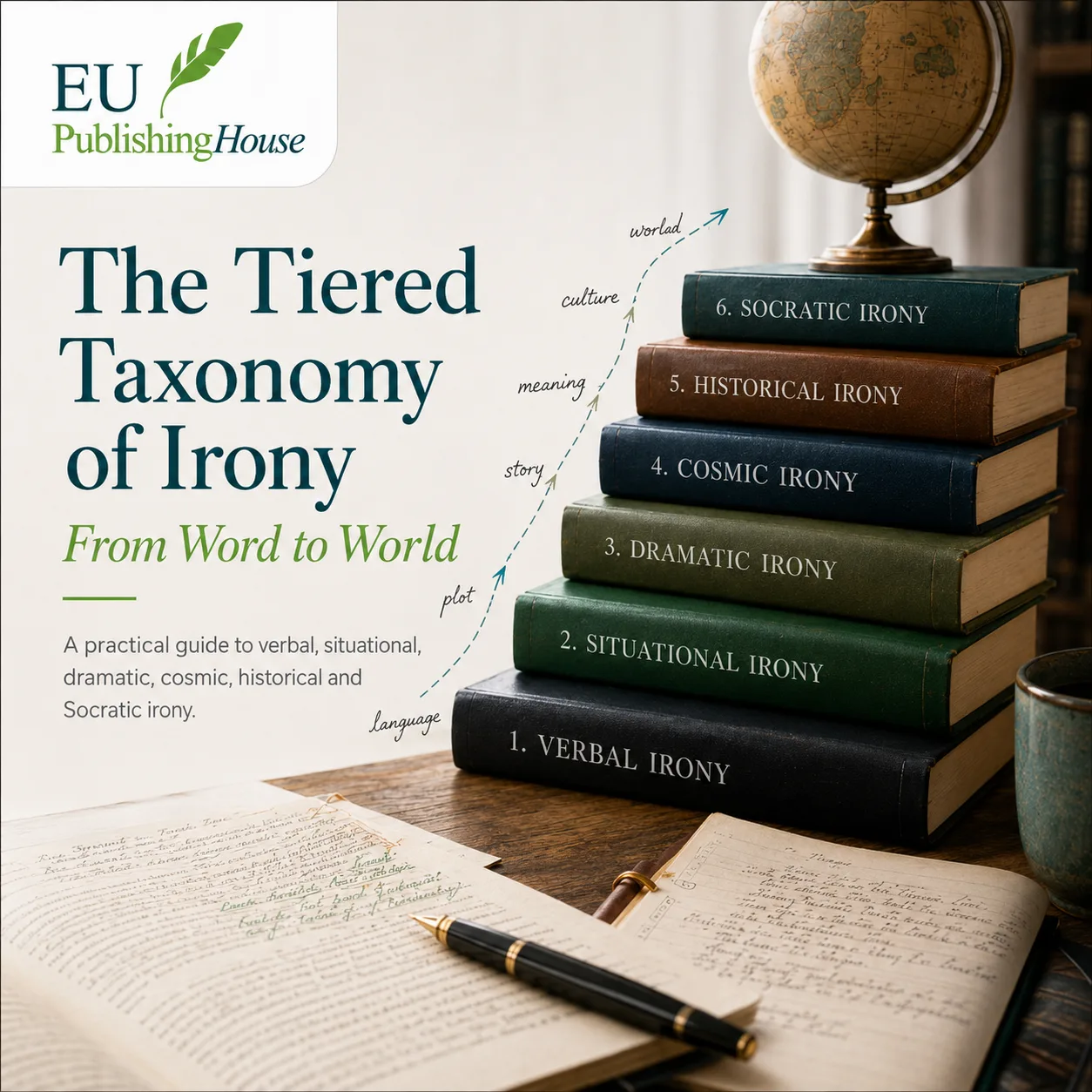
The Tiered Taxonomy of Irony, from Word to World
Most lists of irony types are alphabetical. That is a curious choice, because alphabetical order has no relationship to how the device actually works. So we are not going to do it that way.
Think of irony as a ladder instead. The bottom rung is interpersonal. One person speaks; the words say one thing and mean another. Climb one rung up and you reach plot-level irony, where the events of a story double back on themselves or where the audience knows more than a character does. Climb to the top and you are dealing with structural irony, where an entire narrative, or an entire historical period, lives inside the gap between intention and outcome.
This ordering matters. When you grasp irony at the level of a single line first, you build the muscle that lets you spot it operating at the level of a chapter, and then at the level of a whole novel. Try to start with cosmic irony cold and the device will feel like a vague philosophical mood. Start with verbal irony and the rest unfolds.
A note on definitions before we move further. The pop-culture drift in what people mean by irony is real, but the literary definition has held steady for a couple of thousand years, and it still does the work better than the casual one. We are anchoring this piece in established rhetorical theory of the kind catalogued in Richard Lanham's A Handlist of Rhetorical Terms.
The Tiered Taxonomy of Irony: From Word to World
|
Tier |
Type of Irony |
How It Works |
Simple Example |
Classification Note |
|
Tier 1: Word and Speaker |
Verbal Irony |
The literal meaning of the words differs from the intended meaning, which is understood through context, tone, or shared knowledge. |
“Lovely weather,” said during a storm. |
One of the three principal forms of irony in rhetoric and literary theory. |
|
Tier 1: Word and Speaker |
Sarcasm |
A sharper, often critical form of verbal irony used to mock, criticise or convey irritation. |
“Brilliant timing,” said to someone who is very late. |
A subtype of verbal irony rather than a separate core category. |
|
Tier 1: Word and Speaker |
Socratic Irony |
The speaker pretends to be less knowledgeable in order to expose contradictions in another person’s argument. |
A teacher asks basic questions that gradually reveal flaws in a confident claim. |
A rhetorical and philosophical strategy associated with Socratic dialogue. |
|
Tier 1: Word and Speaker |
Understatement (Litotes) |
Meaning is conveyed by deliberately minimising or downplaying significance, sometimes creating an ironic effect. |
Referring to a major disaster as “a slight inconvenience.” |
Not inherently ironic, but frequently produces irony in context. |
|
Tier 2: Scene and Plot |
Dramatic Irony |
The audience knows something that one or more characters do not, creating a gap in understanding. |
The audience knows a character is being deceived while the character does not. |
One of the three central forms of irony in classical theory. |
|
Tier 2: Scene and Plot |
Tragic Irony |
A form of dramatic irony in which a character’s actions unknowingly lead towards an outcome the audience recognises as disastrous. |
A character tries to avoid a prophecy, unknowingly bringing it about. |
Commonly treated as a specialised form of dramatic irony. |
|
Tier 2: Scene and Plot |
Situational Irony |
The actual outcome of a situation is significantly different from what was expected or intended. |
A fire station burns down. |
One of the three principal forms of irony. |
|
Tier 3: Narrative Structure |
Structural Irony |
A sustained discrepancy exists between a narrator’s perspective and the fuller meaning understood by the reader. |
A naïve narrator praises a society that the reader recognises as unjust. |
Operates across an entire narrative rather than a single moment. |
|
Tier 3: Narrative Structure |
Metafictional / Romantic Irony |
The text draws attention to its own artificial nature, creating distance between story and authorial control. |
A narrator interrupts the story to comment on its fictional status. |
A stylistic and self-reflexive narrative mode. |
|
Tier 4: World, Fate and History |
Cosmic Irony |
Human intentions are undermined by larger forces such as fate, chance, or the apparent indifference of the universe. |
A person seeks security but ends in greater instability. |
A philosophical extension of situational irony. |
|
Tier 4: World, Fate and History |
Historical Irony |
Later events expose a contradiction between earlier intentions and their long-term consequences. |
A reform designed to preserve an institution contributes to its decline. |
A critical historical concept rather than a strictly formal rhetorical category. |
Verbal Irony: The Interpersonal Engine
Before we define verbal irony, let us define what it is not.
Verbal irony is not sarcasm. Sarcasm is verbal irony aimed at someone, used as a weapon. It is one specific deployment of the device, not the device itself. Verbal irony is also not hyperbole, which is exaggeration for emphasis, and it is not lying, which is a sincere attempt to deceive. Verbal irony depends on the audience recognising the gap between what is said and what is meant. If the gap is invisible, the device collapses into something else.
Now the definition. As a figure of speech, irony in its verbal form is a statement in which the literal meaning is the opposite of the intended meaning, and the audience is meant to perceive that opposition.
The opening of Jane Austen's Pride and Prejudice is the canonical case. "It is a truth universally acknowledged that a single man in possession of a good fortune must be in want of a wife." Read literally, that is a sociological claim. Read with the rest of the novel in mind, it is a polite knife. Austen does not believe in the truth she is universally acknowledging. She is mocking the marriage market that does, and she expects you to be in on the joke from the first sentence.
Swift's A Modest Proposal is verbal irony scaled up to essay length. Katherine Mansfield does something similar in shorter strokes. In "The Garden Party," her polite, well-tuned prose sits at a deliberate angle to the class horror it describes. The voice is genteel; the content is not. That is verbal irony as a structural choice.
On screen, the deadpan of What We Do in the Shadows runs the same engine. Vampires explain flatting admin with absolute sincerity, and the comedy lives in the gap between the gravity of the delivery and the absurdity of the content. Flight of the Conchords works the same way; so do Veep and The Thick of It if you want sharper-edged versions of it.
When you write verbal irony, the trick is voice consistency. A character's ironic remarks have to sit inside their established vocabulary, emotional baseline and social context. Drop a perfectly constructed ironic line into the mouth of a character who has otherwise been earnest and the reader will feel the seam. They will not always know what is wrong, but they will know something is. A round of professional editing often catches these tonal slips before a manuscript goes any further, because tone is the kind of thing you stop hearing in your own work after the fifth draft.
Situational Irony: Plot as Reversal
Let us start with the wedding day again, because this is where most readers go wrong.
Rain on your wedding day is not irony. It is weather. It is bad luck. It is a story you will tell at dinner parties for the rest of your life. But it is not situational irony, because there is no expectation rooted in purpose or premise for the weather to subvert. A wedding is not a piece of meteorological infrastructure; rain is not commenting on it.
Now imagine this. A fire station burns down because the chief disabled the smoke alarms to save on the maintenance budget. That is situational irony. The expectation is that a fire station, of all places, will be protected against fire. The reversal cuts back through that expectation and lands on a meaning, which is that institutional pride and budget-cutting can make a building less safe than a private home.
Situational irony is an outcome that reverses the justified expectations established by a situation, a character choice or a narrative premise. It is not the same as a plot twist (which reverses without making thematic sense) and it is not the same as poetic justice (which delivers a morally tidy outcome).
O. Henry's "The Gift of the Magi" is the textbook case. A husband sells his watch to buy his wife combs for her hair; she sells her hair to buy him a chain for his watch. The reversal lands on a meaning about love and sacrifice. Maupassant's "The Necklace" runs the same machinery toward a bleaker conclusion.
In Aotearoa fiction, Mansfield's "The Garden Party" carries situational irony in the way the death of a working-class neighbour intrudes on the comfortable Sheridan family's celebration. Janet Frame's Owls Do Cry is built on reversals of expectation about who in a family is mad and who is sane. On screen, Hunt for the Wilderpeople is a long, satisfying situational reversal. Ricky Baker, a foster kid trying to disappear into the bush, becomes a national news story precisely because of the social services machinery designed to keep him invisible.
The test for whether you have written real situational irony rather than mere surprise is brutal and useful. Remove the reversal. If the only thing that changes is the plot, you have written a twist. If the meaning of the story also collapses, then the reversal was carrying weight, and you have written situational irony. The best writers who come to us for book publishing services for fiction writers have a sense for this distinction in their bones, but it is also a learnable skill.
Dramatic Irony: Weaponising the Knowledge Gap
Dramatic irony lives in a knowledge gap. The audience knows something a character does not, and the story keeps that gap open long enough to generate tension.
This is the device that gets misidentified most often in classrooms, because students confuse it with secrecy in general. A character keeping a secret from another character is not, by itself, dramatic irony. The dramatic irony definition specifically requires the audience to be on the knowing side of the gap. If a first-person narrator is hiding something from the reader as well as from the other characters, that is suspense or mystery. Not dramatic irony.
The classical example is Oedipus Rex. Sophocles built the play on the fact that every Athenian in the theatre already knew the myth. The audience walks in knowing that Oedipus killed his father and married his mother. Oedipus does not. Every confident declaration he makes about hunting down the cause of the city's plague tightens the device. The collision between his certainty and the audience's knowledge is the engine.
Shakespeare's Romeo and Juliet does it again with the tomb scene. We know Juliet is not dead. Romeo does not. The tragedy turns on that single beat of misaligned information.
In Aotearoa writing, dramatic irony does serious work in Witi Ihimaera's The Whale Rider. The reader sees Pai's gift, her place in the whakapapa, her bond with the ancestors, long before Koro does. Eleanor Catton's The Luminaries is structurally dramatic at a larger scale. The astrological scaffolding gives the careful reader patterns to spot that the characters, locked inside their own scenes, cannot. On screen, Waititi's Boy is a sustained exercise in dramatic irony. The viewer reads Alamein clearly as a failing father almost from the moment he appears. Boy keeps idealising him for most of the film. The collision, when it comes, has been earned by every scene in between.
The effect of dramatic irony on an audience is specific and worth naming. It produces a leaning-forward kind of attention, where the reader is watching a character walk toward a wall the reader can see and the character cannot. Used well, it is one of the most powerful tools in narrative. Used carelessly, it becomes smug, and the reader feels lectured rather than gripped.
Timing is the discipline. When does the audience learn the critical fact? When does the character learn it? What is the emotional distance between those two points? Screenwriters tend to be better at managing that interval than novelists are, because in a screenplay everyone is counting beats. If you want to sharpen your sense of pacing for a reveal, study the act-break structure of a tightly built film and then port those instincts back to prose.
Cosmic Irony: Fate as Narrative Engine
Now we get to the top of the ladder. Structural irony operates above the level of the scene or the sentence. It shapes whole narratives, sometimes whole historical readings of an era.
Cosmic irony is the universe pushing back on human intention. Whatever a character wants, whatever they reach for, the larger pattern systematically undermines it. The device is most often associated with hubris and existential futility, and it is one of the easier ones to misuse.
Thomas Hardy is the patron saint of cosmic irony in English literature. Tess of the d'Urbervilles is a long, sustained demonstration of a young woman whose every attempt to claim agency is met by social and structural forces that are bigger than her. Kafka's The Trial is cosmic irony in a more abstract register. Josef K. tries to defend himself against a charge that is never specified, in a legal system that operates on rules he cannot learn, and the gap between his effort and the structure's indifference is the whole point.
In Aotearoa writing, Keri Hulme's The Bone People contains cosmic patterns of harm and reconciliation that exceed any single character's intention. On screen, No Country for Old Men gives you Anton Chigurh as a kind of unstoppable cosmic mechanism. Jane Campion's Top of the Lake sets cosmic irony into a Southern Lakes landscape, where inheritance and geography work on the characters in ways they cannot resist.
The discipline with cosmic irony is restraint. Reserve it for narratives that are explicitly engaging with fate, hubris or futility. If you drop a cosmically ironic ending into a story that has otherwise been about character agency and choice, the reader will feel cheated, not enlightened. It will read as deus ex machina, the author leaning in to save themselves a third act. The device only works when the story has been preparing the ground for it from the opening pages.
Historical Irony: Hindsight as Criticism
Historical irony depends on the audience knowing what comes next, when the character cannot. The reader holds a perspective on events that the character is structurally locked out of.
Shakespeare's Julius Caesar runs on it. The audience watches Cassius and the conspirators speak confidently about restoring the republic, while every Elizabethan in the theatre, and every reader since, knows the Roman republic does not survive. The optimism becomes a slow knife.
Fitzgerald's The Great Gatsby does it through atmosphere. The novel is set in 1922 and was published in 1925, and the entire Jazz Age confidence that Gatsby is chasing collapses four years after the book appears. The reader brings the crash to the party, even though Nick Carraway cannot.
In Aotearoa fiction, Patricia Grace's Potiki does delicate, devastating work with historical irony. The confidence of the developer reads as historical irony against the longer arc of dispossession and return that the novel traces. Witi Ihimaera's historical novels often run a similar engine. On screen, Chernobyl and The Social Network both pull on the device. The audience knows what the disaster cost, or what the empire eventually became, and every confident statement a character makes inside the story becomes a small ironic detonation.
Socratic Irony: Feigned Ignorance With a Purpose
Socratic irony is the oldest of the named varieties and probably the most misused outside the academy. It is not just playing dumb. It is the rhetorical posture of assumed ignorance, deployed by a knowledgeable interlocutor, in order to expose another's logical inconsistencies.
In Plato's Euthyphro, Socrates asks Euthyphro what piety is. He keeps asking. He acts as though he has no idea what the answer might be. He is not pretending in order to deceive. He is pretending in order to teach. The point is to get Euthyphro to discover, through his own contradictions, that his definition of piety does not hold up.
Dostoevsky's Grand Inquisitor scene runs a related dynamic. So do certain interview sequences in long-form documentary, where a host adopts a deliberately naive stance to draw a subject into self-exposure.
The misuse comes when people call any feigned ignorance Socratic irony. It is not. The intent has to be educational or revelatory. A trickster who pretends to know nothing in order to scam a stranger is using the same surface tactic with none of the underlying ethics. Socratic irony has a power-dynamic component, and the power-dynamic has to be on the side of clarity, not exploitation.
The Cross-Media Blueprint
Irony does not behave identically across media. The same device produces different sensations depending on the form it is operating in.
In a novel, structural irony has to be carried by interior monologue, framing devices and the careful management of point of view. In a screenplay, structural irony often has to be made visible. The viewer cannot read a character's interior gap between intention and outcome, so the camera, the editing or the score has to externalise it. In interactive fiction, structural irony becomes player-facing in a way no other medium can match. The player's own choices become the source of the irony, because the game's deeper architecture quietly closes off the agency that the surface offered.
Poetry, particularly the ironic ode, runs a different version of the same engine. Hone Tuwhare's wry, self-deflating moments work this way. The poem performs praise while undercutting the conditions of the praise. The form looks like celebration; the content is dryer than that.
For writers managing irony across a long manuscript, tooling helps. Scrivener and Obsidian are both useful for tracking ironic motifs across a draft. You can colour-code scenes by which character knows what, or which line carries a tonal double meaning, and watch the throughline rather than trying to remember it from a print-out. Once your motifs are in place, the next step is usually manuscript formatting for novels and the cleaner downstream production work, but that is the back end of the process, not the front.
The Narrative Irony Map
Most working writers do not think about irony as a single device. They think about it as a layered system operating on different scales of a story at once.
Micro-irony is the line-level material. A character says something the reader hears two ways. Macro-irony is the architecture. The whole novel is built on a reversal the reader sees forming over several hundred pages.
The most satisfying ironic writing layers these. A single scene can contain verbal irony at the dialogue level, dramatic irony at the audience-knowledge level, and contribute to a situational reversal that lands two chapters later. None of those scales is fighting the others. They are reinforcing.
Consider a wedding speech. The toasting character offers warm, optimistic praise of the couple about how thoroughly they deserve their happiness. The reader knows the marriage has already been quietly arranged for financial reasons, so the verbal layer carries dramatic irony as well. And the celebration itself, in the world of the story, is the moment at which a long-running family deception begins to unravel. Three layers of irony, one moment, and the reader experiences them as a single complex emotional event.
The discipline here is not to overload. If every line in your manuscript is doing three kinds of ironic work at once, the reader stops being able to hear any of them. Layering is a tool to be used at significant beats, not a default mode. Test your layered moments with a small handful of careful readers before you assume they are landing. If a reader feels confused rather than satisfied, you have probably misaligned the reader's information with the character's, or you have planted the setup too thinly for the payoff to find purchase.
The Analytical Framework: A Diagnostic Toolkit
We have been making distinctions all the way through this piece. Now we need a way to apply them.
There are three diagnostic questions you can run on any passage you suspect of using irony, whether you are a student writing an NCEA essay, a book club reader trying to articulate what just happened, or a working writer auditing your own draft.
First, the Expectation Versus Reality Check. Identify the explicit or implicit expectation the text has set up. Identify the actual outcome. Decide whether the gap between them is meaningful, thematically resonant and structurally prepared. If you have an expectation, a reversal and a meaning the reversal generates, you have situational irony. If you have an expectation, a reversal and only the surprise of the reversal itself, you have a twist.
Second, the Knowledge Gap Test. For anything that looks like dramatic irony, ask the simplest version of the question. Who knows what, and when? If the audience does not hold the critical information before the character does, you do not have dramatic irony. You may have suspense, or mystery, or pure surprise. They are different effects, and they need different names.
Third, the Intent Audit. Distinguish authorial intent from character intent. Verbal irony belongs to the character; the character is the one consciously saying one thing and meaning another. Situational and dramatic irony are usually architected by the author, even though they are experienced by the reader. Cosmic and historical irony are author-architected at the level of the entire work.
When you are reading critically, naming the level at which the irony was engineered is half the analysis. A student essay that confuses character irony with authorial irony will lose marks for category error, even if the rest of the argument is good. For tertiary research, JSTOR and EBSCO are the standard sources for peer-reviewed criticism, both of which Kiwi students can access for free through Kotui and the National Library of New Zealand. For citation management, Zotero is now the standard tool. (Elsevier discontinued Mendeley Desktop a few years back, so if a teacher still lists Mendeley in their handouts, treat it as the older recommendation.)
The Writer's Workshop: Planting Setups and Delivering Payoffs
This is where the theory has to start producing prose. The clearest sign that a writer has internalised irony is that their drafts get tighter, not longer. Irony is a compression device. Used well, it lets a sentence carry the weight of two sentences. Used badly, it carries no weight at all.
A few prompts. Use them as exercises if the device is new to you, or as warm-ups if it is not.
For verbal irony: write a scene of a hundred and fifty words in which a character congratulates someone on a promotion the reader knows was arranged through favours. Use no exposition. The reader has to hear the irony in the voice alone.
For situational irony: design a reversal for a short story in which the protagonist's greatest strength becomes the source of their downfall, in a thematically coherent way. Set it somewhere specific. A Wellington flat, a Southland farm, a marae, a Christchurch office tower. Place gives the reversal its weight.
For dramatic irony: draft a sequence in close third person in which the reader knows a room is bugged but the protagonist does not. The reader's awareness has to be carried by setup earlier in the chapter, not by narrator commentary.
Now the revision checklists. For verbal irony, three questions. Is the semantic gap detectable to a careful reader? Is the voice consistent with the character's established register? Is the surrounding context doing enough work that the reader does not need a footnote? For situational irony, also three. Does the reversal emerge from character agency rather than coincidence? Does it map onto the story's central theme? Does it avoid cliché, or at least subvert the cliché it is in conversation with? For dramatic irony, the same. Is the knowledge gap sustained long enough to generate tension without collapsing into smugness? Is the reveal timed and calibrated for emotional impact? Does the character's arrival at the truth feel earned by the scene preceding it?
A practical annotation technique. As you revise, mark up the manuscript by colour. Blue for moments where the audience has information the character does not. Red for moments where the character has information the audience does not. Purple for overlapping ironic moments where multiple devices are operating at once. After three or four passes, you can see the shape of your ironic architecture rather than having to remember it scene by scene.
A note on what comes after the workshop. Once a manuscript is genuinely working at the level of irony and theme, the next set of decisions is practical. There are good resources for understanding how much book cover design costs in Europe, and for thinking about book cover design that signals genre before the manuscript leaves your desk. If you are an Aotearoa writer thinking about distribution, learning how to self-publish on Amazon KDP in Europe will save you a season of guesswork. For writers who would rather not handle the full draft themselves, a ghostwriting service for authors can carry the workload while you keep the structural vision intact.
Misconception Clinic: Dismantling Persistent Errors
A short, blunt section. Frequent mistakes and their corrections.
Rain on a wedding day, and other coincidences. Pop culture has spent thirty years calling unfortunate weather ironic. It is not. Irony requires an expectation built on purpose or premise, and a reversal that comments on it. A picnic getting rained on is bad luck. A weather service convention getting cancelled because the conference centre has a leaking roof is irony.
Verbal irony versus sarcasm versus hyperbole. All sarcasm is verbally ironic, but not all verbal irony is sarcastic. Hyperbole can be ironic, but is not inherently so. Picture a Venn diagram with verbal irony as the larger circle, sarcasm as a smaller circle inside it, and hyperbole as an overlapping circle that crosses the boundary at the points where the exaggeration is doing ironic work.
Dramatic irony in limited-omniscient narratives. If a first-person narrator is hiding something from the reader, that is not dramatic irony, because the reader is on the same side of the knowledge gap as the character. If the text reveals the critical fact to the reader through implication, foreshadowing or a different viewpoint, while the character remains in the dark, that is dramatic irony. The reader knowing and the character not knowing is the only configuration the device permits.
The clichéd twist versus thematic resonance. The test for whether your ironic ending is doing real work is to remove it. If the theme of the story survives the removal, the twist was disposable. If the theme collapses because the twist was carrying it, then the twist was earning its place.
Coincidence dressed up as cosmic irony. The lazy version of cosmic irony is to have a random catastrophe arrive at the end of a story to suggest the universe is indifferent. That is not cosmic irony. That is the author getting tired. Cosmic irony has to be earned by a narrative that has been engaging with fate, futility or hubris from at least the second act onward.
The Interactive Irony Classification Challenge
A short self-test for readers. Try to classify each of the following before reading the explanation that follows.
Excerpt one. A king, in the opening act of a tragedy, declares that he will hunt down the murderer responsible for his city's plague, no matter who that murderer turns out to be. The audience has been told, in the prologue, that the murderer is the king himself. Classify the irony type and justify the choice.
That is dramatic. The audience holds critical information the king lacks, and the gap is sustained for the rest of the play. The device is producing dread, not surprise.
Excerpt two. The opening sentence of a comedy of manners. "It is a truth universally acknowledged that a single man in possession of a good fortune must be in want of a wife." Classify.
Verbal. The narrator says one thing and means another. The audience is meant to perceive the gap and read the rest of the novel through the angle that gap establishes.
Excerpt three. A young husband sells his prized pocket watch on Christmas Eve to buy his wife a set of tortoise-shell combs for her long hair. He arrives home with them to find she has cut and sold her hair to buy him a platinum chain for the watch he no longer owns. Classify.
Situational. The expectations of two loving gifts collide and reverse. The reversal lands on a meaning about sacrifice rather than just generating surprise.
The point of the exercise is not to score well, but to start hearing the differences between the types in the prose itself, the way a musician hears a key change. Once you can hear them, you will start writing them on purpose.
Genre-Specific Irony Blueprints
The same irony device behaves very differently depending on the genre it is operating in. The same line of feigned admiration is a punchline in satire and a tragedy in tragedy.
Horror. Situational irony in horror tends to function as cosmic punishment for hubris or transgression. Frankenstein is the original example. The creator is destroyed by the creation. The reversal is not just a plot move; it is a moral commentary on the act of overreach.
Romance. Situational irony in romance tends to delay union rather than destroy the protagonist. Two characters fail to find each other through a series of expectation-reversals; eventually they do. Dramatic irony in romance generates yearning, because the audience knows the feelings are mutual before the characters do, and the reader leans forward willing them to catch up.
Satire and tragedy. This is the most interesting case. Identical verbal-irony structures produce laughter in satire and agony in tragedy depending on context and stakes. Chaplin's The Great Dictator uses ironic praise of a tyrant to make him ridiculous. Greek tragedy uses ironic praise of a hero's good fortune to deepen the eventual fall. The line on the page can be almost the same; the surrounding pressure decides the response.
This is also why register matters in your own writing. Misjudge the surrounding stakes and a line that should land as tragedy will read as broad comedy, or the reverse. A reader trusts the writer to know which mode they are in. The fastest way to break that trust is to be unclear about it.
Conclusion: Irony as Control
The central claim of this piece is simple. Irony is not a decoration you add to a manuscript to make it sound more literary. It is an engine of meaning. It produces compression, layering, dread, hindsight and structural shape. The writers who handle it well do not necessarily use it more often than the writers who do not. They use it more deliberately.
So here is the homework. Pick a text you read recently, or a draft you are revising. Apply the Expectation Versus Reality Check. Apply the Knowledge Gap Test. Run the Intent Audit. If the irony does not illuminate theme, cut it. If the theme needs sharper illumination, engineer the irony to do that work. Treat the device the way a carpenter treats a chisel. Sharp, deliberate, applied where it counts.
Precision in naming the device is the first step toward precision in wielding it.
For Kiwi writers thinking about what comes after the draft, there are a few useful starting points. The list of top book publishers in Europe gives a working overview of the market a Southern Hemisphere writer is approaching. If you are working in a personal register and want to understand what a memoir is and how it differs from autobiography, that is a useful adjacent read. For practical help with launches and reach, book marketing services for authors is the side of the process most first-time writers underestimate. And if you want a single conversation about the whole route from manuscript to published book, you can find the full list of services at EU Publishing House.